


The 5 Most Costly Mistakes When Migrating Your eCommerce Platform (and How to Avoid Them in 2026)

Migrating from an eCommerce platform is no longer just a technical decision: it's a strategic move that directly impacts revenue, customer experience and business scalability.
In 2026, where operational efficiency, customization and speed of execution make the difference, a bad migration doesn't just create friction... it can completely slow down your growth.
Here are the 5 most common — and most costly — errors when migrating, along with how to approach them from a modern perspective.
1. Thinking that migrating is the solution (instead of questioning the problem)
One of the most common mistakes is to assume that the current platform is the problem, when in reality it may be:
- Lack of conversion strategy
- Poor implementation
- Problems in operation or logistics
- Poor user experience
In 2026, migrating without a diagnosis is an unnecessary risk.
Before making the decision, you need to answer:
- What specific KPI do I want to improve? (conversion, average ticket, CAC, LTV)
- Is the limitation technological or strategic?
2. Migrate technology... but don't evolve the strategy
Changing platforms and keeping exactly the same operation is, in practical terms, changing problems.
Today's competitive eCommerce requires:
- Real omnichannel strategies
- Data-based personalization
- Marketing automation and lifecycle
- Continuous Conversion Optimization (CRO)
If you migrate without redesigning these elements, the impact will be marginal.
3. Choose by price and not total cost of operation (TCO)
The classic “cheap is expensive” today translates into something more sophisticated: Total Cost of Ownership (TCO).
An economic platform may involve:
- Increased dependency on developers
- Limited or expensive integrations
- Low flexibility for scaling
- Performance issues
While a larger investment can reduce operating costs in the medium term.
👉 Strategic Checklist:
- Implementation costs
- Maintenance costs
- Integration costs
- Impact on time-to-market
4. Not having a clear roadmap (or success metrics)
To migrate without a roadmap is to execute blindly.
An effective roadmap in 2026 must include:
- Clear business objectives (not just technical)
- Implementation phases (MVP → optimization → scaling)
- KPIs defined by stage
- Contingency plan (rollback, testing, QA)
In addition, today it is key to integrate:
- Technical SEO strategies (so you don't lose organic traffic)
- Redirection plan (301)
- Controlled data and content migration
5. See eCommerce as a technological project (and not as a business system)
This is probably the most critical error.
eCommerce in 2026 is an ecosystem that connects:
- Marketing (acquisition, retention, automation)
- User experience (UX/UI, speed, mobile-first)
- Operation (logistics, inventory, fulfillment)
- Data (analytics, personalization, AI)
Migrating without considering these layers generates internal disconnection and a poor customer experience.
Conclusion: migrating well is a competitive advantage
A well-executed migration doesn't just prevent losses: it can become a growth accelerator.
Brands that do it right achieve:
- Better conversion
- Lower operating friction
- Faster execution speed
- Real scalability
The key is to stop seeing migration as a “technical project” and start treating it as a strategic business decision.
Contact us to discuss how our team
can boost your digital commerce.
Notas Relacionadas

From Chaos to Control: How to Know if Your Company is Truly Maturing in DevOps
2/6/2026
Business Development
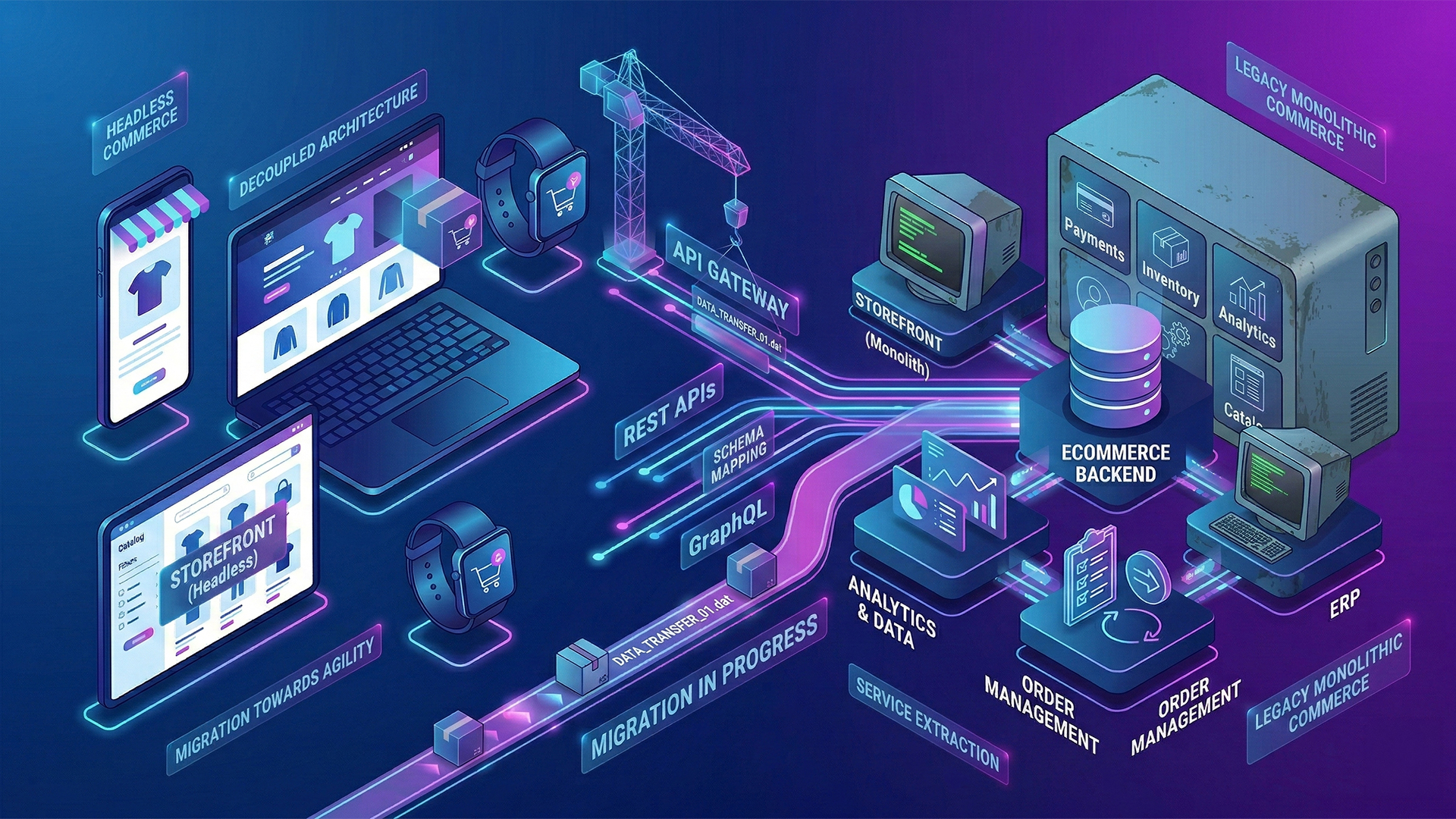
Complete Guide to Migrating Your eCommerce Platform to a Headless Architecture
9/3/2026
Business Development
Financial strategies to survive the high and low seasons of e-commerce
29/12/2025
Business Development
E-commerce cash flow: why it's the biggest challenge (and how to solve it)
19/12/2025
Business Development

We build trust with every line of code: our path to ISO 27001:2022 certification
15/8/2025
Business Development
Service Management System What is it? and how it helps us deliver IT services
1/8/2025
Business Development
The Product Owner as a Strategic Link Between Business and Technology in eCommerce
3/6/2025
Business Development
Checklist for launching an eCommerce store: Everything you need before you start
15/5/2025
Business Development
Assertive Communication Between Agile Teams: Fostering Collaboration and Success
10/10/2024
Business Development

Introduction to Microfrontends: Decomposing the Complexity of Web Applications
17/7/2024
Business Development


Optimizing SUCCESS: The Importance of Performance Monitoring and Analysis in eCommerce Platforms
17/4/2024
Business Development


How to Create a Successful Business Case for the Migration of Your E-Commerce Platform
11/3/2024
Business Development

Agile Methodology: An Approach That Reduces the “Pain” of an Implementation
7/2/2024
Business Development


Contact us to discuss how our team
can boost your digital commerce.


